
The Single Point of Failure: How a SaaS Product Development Company Builds Multi-Region SaaS That Stays Up
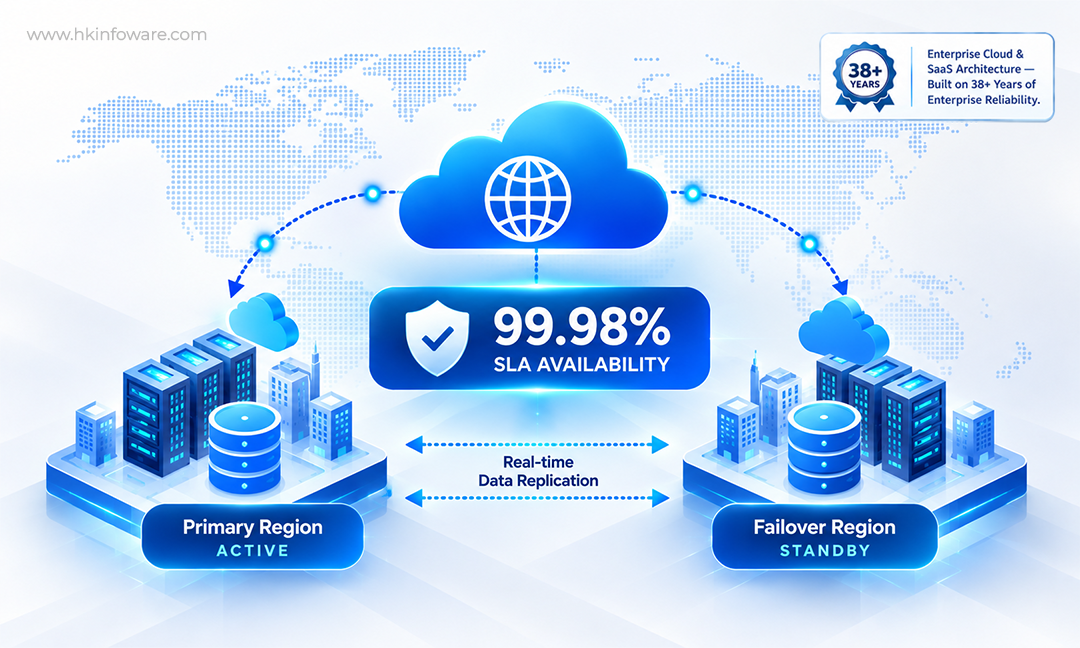
For modern enterprises, system downtime is a direct threat to revenue, brand trust, and operational integrity. The costs quickly become apparent when an enterprise app goes down. Support lines grow, revenue stops, and clients begin to question if they made the proper choice. Because of this, more businesses are using SaaS Product Development Company to create infrastructure that can continue to function even if an entire cloud region is lost. Compared to the typical single-region setup, it requires a different way of thinking. As an enterprise technology solutions company, we start with failure in mind. Automated failover, data sync, and replication are not post-launch enhancements; rather, they are components of the foundation.
The Hidden Risk: Single Points of Failure in SaaS Infrastructure
Any component without a backup is a single point of failure (SPOF). If that component fails, the entire application collapses. In traditional software deployments, common SPOFs include:
A single zone of availability – Everything is lost if there is a power outage or a problem with the local provider.
Centralized Monolithic Databases – A single primary database restricts write throughput, and nothing works if it fails.
Static Domain Routing – Inflexible DNS configurations without automated health checks prevent seamless traffic redirection during an outage.
By distributing the system across multiple locations, good saas development services eliminate these risks and ensure that there is always a safe place to transfer traffic.
1. Database Replication: The Hard Part
The most difficult issue in high-availability architecture is arguably maintaining data consistency across locations. The majority of teams choose between three patterns.
Active-Passive Replication:
In this architecture, a primary read-write database resides in the main region. An asynchronously updated copy is kept on standby in the second region. If the primary fails, the replica is promoted. You may lose a few seconds of recent writes, but recovery is straightforward.
Active-active (multi-master):
Writes are accepted in every region. Although it is more difficult to run, this provides extremely low latency for worldwide programs. Clear conflict-resolution guidelines are necessary since writes can clash, and some systems also use consensus techniques like Raft or Paxos. It is strong, but before you commit, consider whether you really need it.
Global read replicas:
Read-only copies are positioned near users. The main database is under less strain and queries become faster.
2. Storage and Sync Beyond the Database
Databases are just one aspect of the situation. User uploads, media, and sessions need protection too.
Files can be automatically replicated to a second area using object storage like AWS S3 or Azure Blob Storage.
CDNs reduce server load and absorb spikes in demand by serving static material from nearby sites.
When traffic moves to a different area, users do not log out thanks to session and cache replication utilizing Redis Enterprise.
3. Automated Failover Routines and Traffic Management
Your failover is too slow if your staff must get up at three in the morning to flick a switch. A reliable setup automatically handles it:
Smart DNS and health checks –
Cloudflare and AWS Route 53 are examples of services that continuously monitor each area. Traffic shifts to one that responds when the other stops.
Tight recovery targets –
RPO is the amount of data you can afford to lose, and RTO is the recovery time. Teams can reduce both to seconds or minutes, depending on the architecture and funding. These goals must be put to the test, not only stated.
Circuit breakers and rate limiting –
Instead of collapsing with a failing service, the system as a whole cuts it off.
4. Guaranteeing 99.98% Uptime SLAs for Enterprise Clients
Including maintenance periods, a 99.98% Service Level Agreement (SLA) permits roughly 1.75 hours of downtime annually. You can not just happen to hit it. It requires:
Safer deployments –
You can send code without bringing the product offline with canary and blue/green releases.
Chaos testing –
Break things on purpose, in staging and sometimes production, to confirm failover works when it counts.
Real observability –
Effective monitoring and alerting reveal resource issues, database locks, and latency spikes before customers do.
Conclusion
Business clients anticipate that your product will be available when they need it. Planning for failure early, selecting the best replication strategy, safeguarding storage and sessions, and automating failover are all necessary to do that. All of this will be built with the assistance of a skilled SaaS product development company, enabling you to satisfy stringent SLAs as you expand.