Monolithic Architecture vs. Cloud-Native SaaS: Why Indian Enterprises Are Migrating in 2026
More than most people realize, business velocity now depends on the fundamental architecture of the software that powers the company. Indian enterprises relied on outdated, monolithic systems that were fastened to regional infrastructure for many years. That was wonderful until it stopped working. These earlier architectures began to encounter actual scaling boundaries as processes became increasingly complicated. In order to achieve the agility, security, and long-term cost control that older systems simply cannot provide, forward-thinking businesses are now purposefully moving toward cloud-native SaaS development. That transition is much less difficult when you work with an experienced enterprise software development company in India. It enables businesses to transition from rigid hardware-bound configurations to multi-tenant systems that are genuinely designed to manage expansion.
1. Architectural Evolution: Single-tenant Monolith versus multi-tenant Cloud
The real difference between old-school software and modern SaaS comes down to how it’s hosted and structured underneath.
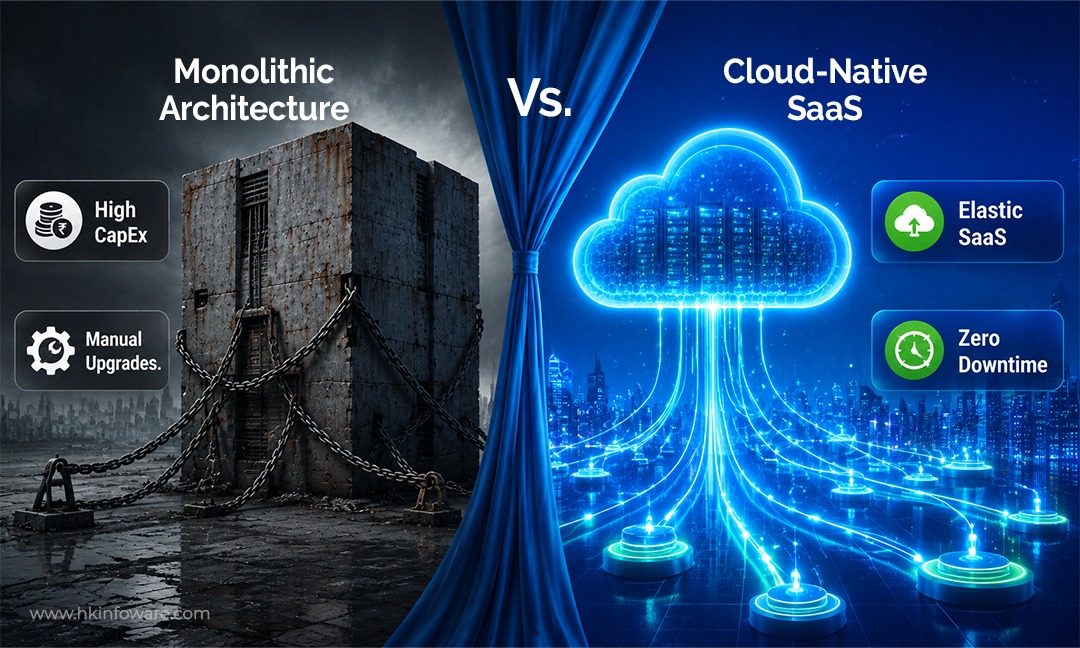
- Monolithic legacy systems: Run on single-tenant frameworks. Each client receives a stand-alone codebase that is housed on dedicated physical or cloud servers. What is the catch? Version fragmentation and a mound of technological debt result from the need to manually push each update, client by client.
- Cloud-Native SaaS: Designed around multi-tenant architectures. Multiple businesses are served simultaneously by a single, unified infrastructure that maintains rigorous data isolation while sharing the underlying processing capacity.
2. Financial Dynamics: Shifting from CapEx to Predictable OpEx
The way businesses budget for workplace technology has undergone significant transformation.
- Traditional CapEx Heavy: Conventional monolithic installations have high capital expenditures (CapEx) because of their large upfront licensing prices, significant private hardware investments, and sizable internal IT staff
- Predictable SaaS OpEx: SaaS completely changes that paradigm. Subscriptions turn costs into predictable operational expenses, eliminating any upfront hardware risk and transferring server upkeep to the SaaS Product Development Company.
3. Deployment Velocity & Continuous Delivery
Getting to market fast isn’t a nice-to-have anymore — it’s a strategic requirement in 2026.
- Monolithic Update Bottlenecks: Local installations, planned downtime, and the ongoing possibility of something breaking in the middle of an upgrade are typically associated with patching a legacy application.
- Zero-Downtime SaaS Upgrades: Cloud-native Saas avoids all of that. Every user is on the most recent, safest version as soon as they log in—no downloads or waiting—because features, security patches, and system updates are distributed centrally via cloud pipelines.
4. Instant Elasticity vs. Hardware Bottlenecks
Legacy applications encounter physical scaling barriers as commercial data quantities increase.
- Monolithic Scaling: Needs laborious database partitioning, reconfiguring local networks, and buying expensive physical servers.
- Cloud-Native Elasticity: Cloud systems automatically scale to address traffic spikes without requiring localized tech overhauls or performance drops because they are built natively with microservices.
Summary Breakdown: Monolith vs. Cloud-Native SaaS
| Feature | Monolithic Legacy Software | Cloud-Native SaaS Platform |
| Hosting Model | On-Premise / Isolated Server | Centralized Multi-Tenant Cloud |
| Financial Burden | Heavy Upfront CapEx + AMC | Predictable Subscription OpEx |
| System Updates | Manual, slow patch deployments | Automated, global rollouts |
| Scalability | Manual hardware provisioning | Instant, elastic cloud scaling |
Driving Real-World Transformation Across Sectors
Three decades of engineering expertise at HK Infoware Limited assist businesses transform outdated systems into more robust ones in a variety of industries:
- Education: Our cloud-enabled School ERP & Learning Platform (TulipDesk) replaces local databases, consolidating academic, administrative, and admissions processes under one roof.
- Hospitality: Using a multi-channel Hospitality SaaS Platform to modernize daily processes and permanently eliminate human spreadsheet errors.
- E-Governance: The development of safe, role-based e-Governance platforms that speed up and improve the transparency of public service delivery.
The Bottom Line
Monolithic systems served their purpose when air-gapped isolation was the priority. But they are now more of a bottleneck than a foundation. Adopting a cloud-native architecture is now more than just a technological improvement—it is necessary to remain resilient, competitive, and scalable. Working with the best enterprise software development company in India can make all the difference between creating something truly future-proof and struggling along on outdated infrastructure.