SaaS Development Services: How to Build a Scalable Product That Grows With Your Business

There is no denying that software-as-a-service has altered how modern businesses operate. Businesses are moving away from rigid, legacy installations in favor of cloud platforms that enable them to streamline operations and unlock recurring revenue streams. The simple part is launching the product, which is something that most founders do not know until it is too late. The real test comes when your user base starts growing and your architecture either holds up or falls apart. That’s where working with an experienced SaaS Development Services team makes the difference — building something that can actually handle growth, not just survive a demo.
1. Architectural Foundations: Multi-Tenancy and Microservices
It is necessary to go beyond monolithic software frameworks in order to create a scalable SaaS offering. Modern architectural patterns that can manage unexpected surges in user demand without compromising system stability are essential for a platform that is ready for the future.
Multi-Tenant Architecture:
Provides complete data isolation and security while serving thousands of different clients concurrently from a single, shared infrastructure. This significantly lowers operating expenses and minimizes server overhead.
Microservices Architecture:
The platform is divided into several loosely connected services. One feature, like reporting or payment processing, can scale on its own without causing the application as a whole to become bottlenecked if it receives a lot of traffic.
Cloud-Native Elasticity:
Adapts cloud resources dynamically in response to real-time application loads by using dynamic auto-scaling.
2. Speed-to-Market with Automated CI/CD Pipelines
Speed matters in SaaS. Someone else feels the gap if you take too long to deliver. A competent SaaS product engineering business incorporates continuous integration and deployment directly into the development process, making release a routine rather than a significant, dangerous event. What that actually looks like:
Zero-downtime updates:
Users hardly notice when patches and new features are released in the background.
Faster iteration:
Instead of lingering in a backlog for months, client feedback is translated into released features more quickly.
Built-in QA:
Automated security testing is carried out on each release thanks to built-in QA
3. Scalable Data Management and High Availability
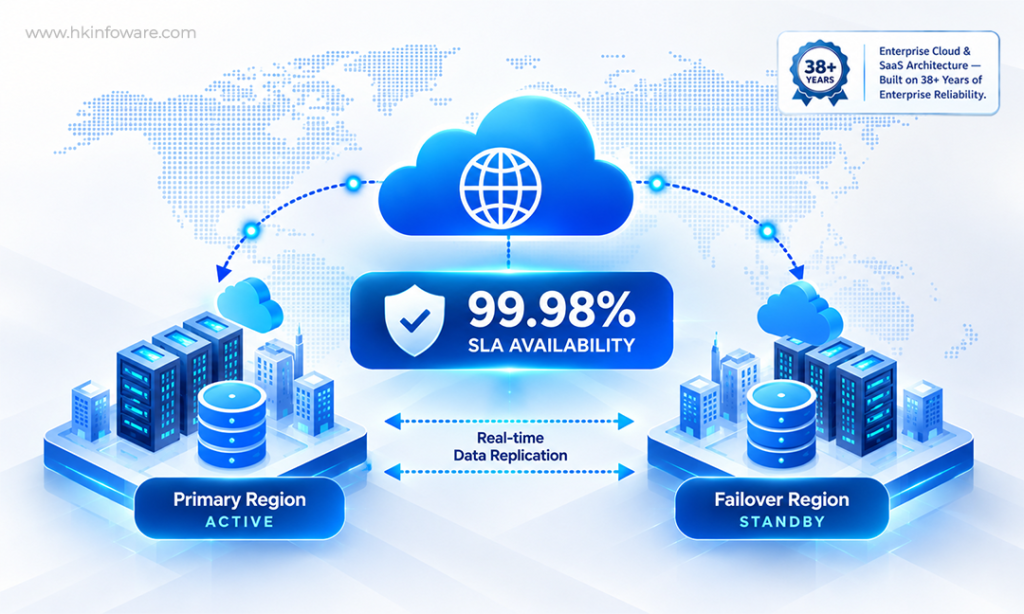
Your platform must be able to manage a lot more transactions, logs, and queries as additional users join it without performance degradation. A few things help here:
Database replication and sharding:
Distribute the workload among several servers, maintaining quick query speeds even as data volumes increase.
CDNs:
Store content closer to users worldwide, ensuring pages load rapidly regardless of the user’s location.
Redundancy and failover systems:
Designed to maintain uptime around 99.99%,
because downtime is costly in terms of both money and confidence.
4. Enterprise-Grade Security and Compliance
Gaining user trust is a must for scaling. From the beginning, custom enterprise SaaS solutions must adhere to stringent international data privacy laws and security procedures.
Role-Based Access Control (RBAC):
Enforces stringent permission hierarchies designed for enterprise clients to safeguard sensitive operational data.
End-to-end encryption:
Protects data against hackers and illegal access by encrypting it while it is in transit and at rest.
Regulatory Compliance:
To enable seamless enterprise adoption and growth, it complies with international standards including GDPR, ISO, and HIPAA.
Conclusion:
Developing a SaaS platform involves more than just coding; it involves creating a digital asset that must last for years. Early investments in SaaS Development Services help teams avoid the agonizing rebuilds that result from scaling on unstable foundations. If you have a well-designed multi-tenant architecture, automate your deployments, and prioritize security, your product will be constructed to grow rather than break the moment it becomes popular.